
Substance Use

Cannabis use care, written from your assessment.

Outpatient cannabis use disorder treatment in Lakeway, Texas. Motivational enhancement, CBT, and contingency management, prescribed from a 2 to 3 day comprehensive assessment and delivered across four levels of care. Same-day or next-day admission.

Same-day or next-day admission Prescribed care plan Most insurance accepted
A white man in his early 30s, short sandy-brown hair, sage linen overshirt over a fitted cream tee and oat-linen trousers, mid-body three-quarter profile standing at a tall paned wood-mullion window in a sunlit white-oak home study, both hands wrapped loosely around a stoneware mug at chest, calm grounded reflective gaze through the window onto a soft live-oak canopy in warm late-morning Hill Country light.

Recognizing Cannabis Use Disorder

Treatable, and treated specifically.

Cannabis use disorder is a clinical condition with defined diagnostic criteria, named behavioral modalities, and a treatable course in outpatient care. Your plan begins with recognition, then a written treatment plan, then the level of care that fits.

An estimated 20.6 million people aged 12 or older in the United States meet criteria for cannabis use disorder in a recent twelve-month period, the second most common substance use disorder behind alcohol use disorder, and rates have risen sharply as average THC potency in available products has climbed (SAMHSA NSDUH 2024). Roughly three in ten people who use cannabis develop cannabis use disorder, with risk markedly higher for those who begin use during adolescence (NIDA). The Stepwell Center treats cannabis use disorder as the clinical condition it is, with a written plan and a defined modality mix, alongside the other substance use conditions we cover.

Recognition often arrives gradually, and frequently after a stretch of dismissing the possibility because cannabis is widely framed as harmless. Daily use has crept upward, the products have moved toward higher-potency concentrates or vape pens, sleep has begun to depend on it, motivation, focus, and follow-through have softened, and prior attempts to take a break have not held. The clinical definition follows that picture. Cannabis use disorder is diagnosed under the same diagnostic frame as any substance use disorder, with at least two of eleven criteria present in a twelve-month period, severity rated mild, moderate, or severe, and a recognized withdrawal syndrome included among the criteria (NIDA). Outpatient care is appropriate across that severity range when the assessment indicates the level of structure that fits.

Your plan begins with a 2 to 3 day comprehensive assessment that integrates clinical interview, qEEG brain mapping, pharmacogenetic testing when medication for a co-occurring condition is on the table, and standardized psychological testing. The output is a written care plan that names the modalities, the medication considerations for any co-occurring anxiety, depression, or attention difficulties, and the level of care that fits your clinical profile. The plan is delivered across PHP, IOP, Evening IOP, and Outpatient at our Lakeway, Texas facility in the Lake Travis corridor, by the same clinical team across each step.
How We Treat Cannabis Use Disorder

Six modalities, combined.

Specific evidence-based modalities, named in your prescribed plan rather than left implicit. Your combination is selected from these and others based on your assessment.

  1. Motivational Enhancement Therapy

    A collaborative, change-focused conversation that strengthens your own reasons for change rather than imposing them. Particularly load-bearing for cannabis use disorder, where ambivalence is the norm because the substance is widely framed as harmless. Used early in every plan to align the work to where readiness actually sits.

  2. Cognitive Behavioral Therapy

    CBT for cannabis use disorder identifies the thought-feeling-behavior loops that lead to use, then rehearses new responses in structured exercises, including specific strategies for managing sleep, anxiety, and boredom that often drive daily use. Pairs effectively with motivational enhancement and contingency management as the behavioral backbone.

  3. Contingency Management

    A structured incentive approach with three decades of evidence for cannabis use disorder. Verifiable abstinence is reinforced with predefined incentives on a documented schedule, reshaping the daily decision loop. Used alongside CBT and motivational enhancement rather than instead of them.

  4. Family-Based Therapy

    Family or partner sessions are integrated when the assessment identifies household dynamics that maintain the use pattern, with strong evidence for cannabis use disorder in younger adults and emerging adults still living in or close to the family system, rather than offered as an optional add-on.

  5. Skills Groups and Relapse Prevention

    Process and skills groups complete the weekly mix in PHP and IOP, with relapse-prevention work calibrated to the cannabis withdrawal window, when sleep, irritability, and cravings peak. Group time builds the alternative routines that hold up after the intensive phase steps down.

  6. Coordinated Medical Care

    Cannabis use commonly affects sleep, anxiety, motivation, and attention, and these are tracked from the assessment forward rather than waiting for symptoms to surface. Medication for co-occurring anxiety, depression, insomnia, or attention difficulties is selected from your clinical interview and pharmacogenetic profile when indicated, handled by your care team rather than handed off.

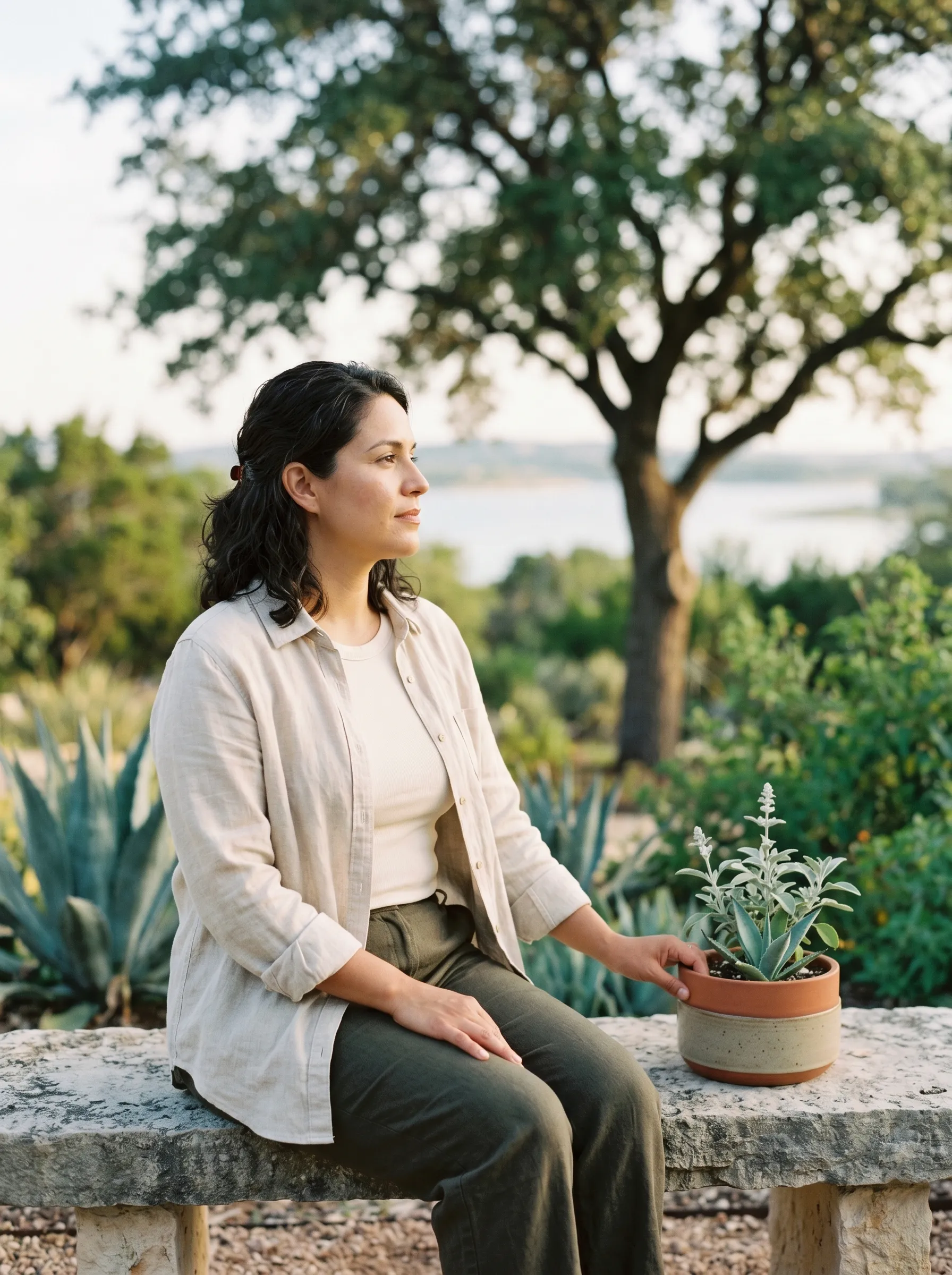
A Hispanic-Latina woman in her late 30s seated three-quarter profile on a sun-warmed limestone bench in a modern Hill Country native plant garden, one hand resting on a stoneware planter of silver salvia, calm grounded reflective gaze toward a single live-oak in the middle distance, agave and pale lake water in soft bokeh beyond, late golden afternoon light.

The Prescribed Care Model

One plan, delivered across four levels.

Cannabis use disorder rarely arrives as a single problem. Sleep, anxiety, motivation, work performance, and family life have usually been organizing around the cycle for months or years, and a plan that treats only the cannabis side tends to leave the rest pulling the pattern back into place. Stepwell's Prescribed Care Model assembles a plan that holds the whole picture.

After your assessment, your prescribed plan names the level of care, the modality mix, and the relapse-prevention structure that fits you specifically. You might begin in PHP for the first weeks of stabilization through the cannabis withdrawal window, then step down to IOP across three or more days per week, then continue in standard Outpatient as stability holds, all with the same clinical team. If daytime sessions are not workable, Evening IOP delivers the same content after hours, often the entry point for working adults in the Lake Travis area looking for outpatient cannabis care that fits a real schedule.

Many cannabis plans interlock with related work. Anxiety often sits underneath nightly use, depression often travels with daytime use, and attention difficulties and unprocessed trauma are common companions. Integrated dual diagnosis care addresses each thread inside one plan rather than handing pieces off, and integrated treatment has stronger outcomes on both substance use and psychiatric measures than treating either condition separately (SAMHSA). Related substance use conditions including alcohol use disorder and stimulant use disorder are treated in the same continuum when the pattern overlaps.

By the Numbers

Cannabis use disorder in perspective .

Past-year cannabis use disorder

Past-year cannabis use disorder

US population aged 12 and older, SAMHSA 2024 NSDUH

Of users develop CUD

Of users develop CUD

Higher risk with adolescent-onset use, NIDA

Day assessment

Day assessment

Before any plan is written

Levels of care

Levels of care

PHP, IOP, Evening IOP, Outpatient

Find the level that fits.

Common Questions

What people ask about cannabis use disorder treatment.

Pulled from the questions families and prospective patients ask most often when considering outpatient cannabis care.